Friday, 29 April 2016

Meet the Borrower: Thomas Campbell


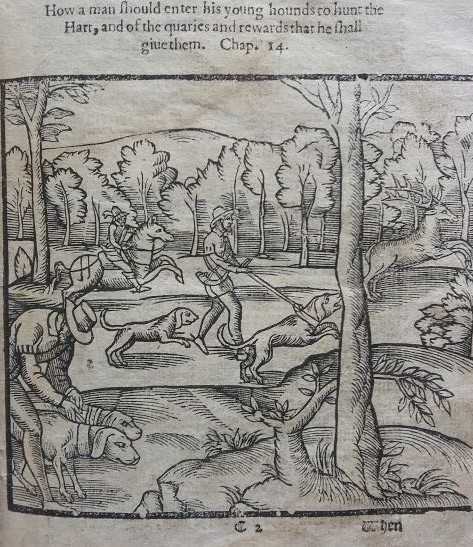
The next in our Meet the Borrower series is Thomas Campbell, a Game Keeper from Innerpeffray. On his first recorded visit to Innerpeffray (August 1859) he borrows two books - an 1842 bound copy of Chambers’ Information for the People and The Noble Arte of Venerie or Hunting, published in 1611.  The latter has been in the collection since its foundation in the 1680s by David Drummond, 3rd Lord Madertie. As well as practical tips on, for example, the breeding of dogs, it includes poems from the perspective of the hunted fox or hare, and fabulous woodcuts feature throughout. Borrowed in combination with the Chambers volume, however, it seems he may have been looking for practical information, even in so old a text. The Chambers volume contains sections on a wide variety of subjects, from mechanics to flowers, but also ‘the horse’ and ‘dog-sports’.


When he returns his books in September, Thomas picks out another two titles, this time both novels by Walter Scott, showing he is willing to read for pleasure as well as for information. Scott is far from an unusual choice. While Innerpeffray didn’t hold the novels until 1855, when the majority of the 19th century collections were purchased, they proved very popular with borrowers. This is not only evident in the borrowers’ registers, but also through the fact that very few survive in the Innerpeffray collections, literally read-to-pieces!


Thomas spends winter 1860-1 with Gordon-Cummings’ Five Years of a Hunter’s Life, chronicles the life of a Scotsman exploring southern Africa. As well as page-turning passages about the chase of various species exotic to a Scotsman, it describes native populations and the people he meets on his journey. Similarly, borrowing Davis’ The Chinese, Thomas has the opportunity to read about customs, religion, different cities and popular literature.

With interest turning to lifestyles and pursuits overseas it is possible that Thomas Campbell may have been considering emigrating. Emigration was increasingly becoming an option in the period, and the borrowers’ register at Innerpeffray also provides evidence of this. Emigrant’s Manual is borrowed by 5 different individuals 1860-1863, though since the volume has not survived there’s no clue as to which edition, or the locations on which it focused. Among the ephemera at Innerpeffray is an immigration board which displayed the costs of sailings, and has reputedly been on display here since the relevant time.


While records at Innerpeffray can’t tell us what happened to Thomas Campbell, we can infer from his borrowing record what may have prevented him from borrowing any more books. The register tells us that the length of time books may be borrowed in this period is 3 months, but Thomas returns Adventures of British Seamen after 3 months and 5 days. Since there’s no record of his having paid a fine, it’s possible the library keeper did not let him borrow again.


Date Borrowed
17 Aug – 20 Sep 1859
20 Sep – 24 Nov 1860
24 Nov – 23 Jan 1860-1
23 Jan – 3 Feb 1861
8 Apr – 13 Jul 1863
Title (Volume)
Chambers’ Information for the People
Gascoigne’s Noble Arte of Venerie or Hunting
Walter Scott’s Antiquary
Walter Scott’s Guy Mannering
Gordon-Cumming’s Five Years of a Hunter’s Life
Davis’ The Chinese (v.1)
Adventures of British Seamen
Date
1842
1611


1850
1844

Saturday, 5 March 2016

Meet a Borrower


As the library opens its doors again for the 2016 season, we’re adding a new feature on display beside our Borrowers’ registers.  While our exhibitions upstairs focus on “Drink” and “Around the World in Innerpeffray Books”, downstairs we’ve space to feature the borrowing patterns of individual readers for the very first time.


Inspired by trips to the local sweet shop of the same name, we’ve chosen a Durward as our first “Meet the Borrower”. A gardener at Millearn, 3 miles from Innerpeffray, George Durward borrows his first Innerpeffray book in July 1872, Modern Eden (or, simply put on the spine, “Gardener’s Guide”). He then borrowers another gardening book in 1878, so his early borrowings seem to complement his occupation. The second book, Thomas Reid’s Scots Gard’ner in October 1878, is already almost 200 years old by the time George borrows it, but it remains one of the more popular books with visitors to Innerpeffray past and present, and has now been fully digitised and made available for purchase in our library shop.


George’s reading begins to broaden, taking out A Natural History of Barbados in 1879. Though concerned partially with plants, it also details animals living in the area and its topography and is richly illustrated. A large book, it is difficult to imagine his getting it to and from the library in one piece, but it was indeed safely returned on time and is one of the books we sadly didn’t have space for in our Around the World exhibition this season.


By 1880, George seems to have developed a taste for history, taking out two volumes of Macaulay’s History of England successively in January and May, then going on to take out The Scots Magazine for the year 1782. The Scots Magazine is packed full of news and articles, and this particular volume (44) covers such topics as volcanoes in Iceland, affairs in America and Ireland, the influence of climate and many many more. With drink on the brain thanks to our new exhibition, we even found an excellent 2 page exploration into the use and effects of tea. With such a rich diversity of content it’s difficult to infer why George may have taken out this particular volume: given that it was borrowed in 1882, it could even be something so simple as looking at how far things have changed in the last 100 years.

George Durward’s reading journey, in books borrowed from Innerpeffray at least, eventually moved onto fiction, borrowing his final library book in 1892, Walter Scott’s Tales of a Grandfather. In 1887 the family story continues when a “scholar” of the same name and address, perhaps his son, begins his Innerpeffray borrowing record with fiction, and with Walter Scott’s Quentin Durward. What better way to begin than with the adventures of your namesake?


It is always amazing to us and to our visitors how full a picture of life in the area throughout history we can paint using our borrowers’ records. In the coming months, and as part of an ongoing PhD project on the books and their borrowers at Innerpeffray, we will be meeting more borrowers and looking at the stories each individual record has to tell.

George Durward's Borrowings:
9th July 1872         Modern Eden: : or the gardener's universal guide, 1769
31st October 1878  Scots Gardener, 1683
24th April 1879      The natural history of Barbados, 1750
1st January 1880     Macaulay’s The History of England (Volume 5) 1861
13th May 1880        Macaulay’s The History of England (Volume 6) 1861
20th April 1882      The Scots magazine (Volume 44) 1782
23rd October 1884  The life & letters of Princess Alice, 1864
2nd  February 1892 Walter Scott’s Tales of a Grandfather     

Saturday, 6 February 2016

Lost and fined? Missing piece of library history returned after 128 years

It's National Libraries Day - a perfect time to celebrate Innerpeffray library's history - and now an irreplaceable piece of that history has been returned after it was found tucked inside a book 200 miles away.

A library well-wisher found a handwritten sheet of 19th century paper listing names, addresses and book titles tucked inside a second hand book in a shop in Kendal. He sent the sheet to Innerpeffray, thinking that it might be of interest, since all but one of the addresses were given as nearby Crieff. On opening the envelope, Library Keeper Lara Haggerty was astonished to find that it was in the familiar handwriting of one of her predecessors. Lara was able to identify the document by comparing it with the relevant period from Innerpeffray’s unique record of borrowers.


The return of the piece is remarkable since the paper itself made no mention of Innerpeffray at all. Fortuitously, the discoverer had visited the library in the 1980s and remembered seeing similar records during his visit.  His letter describes the discovery and the potential link to the library he’d visited decades ago as ‘a bit spooky’.  

The page lists books from the library which had not been returned between 1882-1888. It seems that one of the previous Library Keepers went through the register searching for books which were unaccounted for, and successive keepers duly sought after their return. Remarkably, every single book on the list was eventually recovered and all of them are still on the shelves at Innerpeffray. Mrs Birnie, Keeper from 1890-1914, added a small note to the bottom of the borrowers’ register noting just how late one of the items was!

The return of this document gives new evidence of the steps that diligent library keepers took to recover any books missing from the collection. What we don’t know, however, is whether the librarian made any charge or fine for such an overdue book.

Tuesday, 24 November 2015

Recommended Reading

Recommended Reading

Visitors to the Library at Innerpeffray often ask how or why individual books made it into our collections. This month, to coincide with Book Week Scotland, we’ve sifted through the archives at Innerpeffray to see whether we can find out how some of our earlier books came to be available for borrowing.


The Library at Innerpeffray was founded by David Drummond, Lord Madertie, in the 1680s. His will states that “I have lately begun a library” in the top room of the family chapel, and that its books are to be available for borrowing for the benefit of all. We can identify some 400 books from the original collection due to his helpful habit of marking his books “Madertie” on the top left corner of one of the first few pages (as above). None of our archival material goes back far enough to tell us where his books were coming from, or what he was choosing, but the books themselves show us that it was not always a matter of choice. For example, the image below shows the signature of Patrick Lord Drummond dated 1582, taken from the bottom of a “Madertie” book, Cosmographie. This shows that material was being passed down through the family, and that the collection Madertie was making available to the public contained some books which he had inherited. We have no evidence to show that he was choosing any books for a public readership, rather, it seems that he was making public his own collections, whatever they happened to be.


 Lord Madertie had left money in his will with the express intention that the library “be augmented by my successors yearly in time comeing”. While information on the library in the years after Madertie’s death is sparse, it is evident from the lack of books from that period that little had been done by way of increasing the collections. The Mortification Book, a document held in a private collection but to which the library has been given access, contains minutes from the meetings of the Innerpeffray Mortification (the trustees of the library) from 1741-1773, and includes some transaction records. Of the historic transactions, only 2 references to book buying are recorded up to 1741, in 1709 “for the buying of books to augment the library … 333-05-08”, and, in 1723/4, 500 merks scots. Though the sums are large, book buying does not occur with any frequency, and we have no means by which to test whether what was being bought reflected the whims of the purchaser (always a trustee, never the keeper) or the wants of the borrowers.


In the 1740s, however, the archives at Innerpeffray do give us something to go on. Robert Hay, an Englishman who had recently begun a career in the church, inherited the estates of Innerpeffray and Cromlix in 1739, and took up the family name of Drummond as part of his inheritance. Already a man of the church, he eventually ascended to the role of Archbishop of York in 1761. In 1744 he dictated to a secretary a list of “books proposed to be brought into the Library at Innerpeffray, as occasion offers”, a list which remarkably remains within the archives today. The list comprises four categories: divinity, classics, history & politic and miscellanea. It ranges from giving extensive details on particular volumes (date, format, number of volumes, and place of publication) to recommended authors in general. Whilst divinity takes pride of place on page one (though the list is unpaged, Divinity is given immediately below the title), it is classics which is the largest, closely followed by politics and history. There is a stark lack of philosophy, even among the classics. Miscellanea contains many literary works in English (Swift, Chaucer, Congreve, Shakespeare) and French too (Racine, Molière). This list does not identify gaps Hay Drummond knew of in the Innerpeffray collection. In fact, it shows us that he did not know the collection that well, since several of the titles he listed had been in the collection a long time, displaying the “Madertie” signature associated with our founder. It does, however, give us a rare insight into what a man like Hay Drummond would recommend for the shelves of a lending library.


Only around a third of the recommended titles from this list appear in the collection today, which is far less than can be accounted for by mere attrition. Further entries in the Mortification Book show that there was a ban on purchasing items from the list until a space for them, in the form of a new building commissioned by Hay Drummond (in which the collection remains today) had been completed. While book buying did not start again until 1765, the list was not forgotten about in the intervening years. A letter to the librarian from a trustee in January 1772 still refers to the “Archibishop’s list”, but goes on to discuss financial dealings with the bookseller, a Mr Drummond, who it seems had sent across various books mentioned on the list before the library had secured funds to pay for them.  The casual “as occasion offers” from the header of the 1744 list reminds us that, as even the future Archbishop knew, books cost a significant amount of money, money which could not be guaranteed always to be available to the library.


Now that the archives have taken us some way towards knowing what the patron of the library thought the public should be reading in the mid eighteenth century, it would be fascinating to see whether the borrowing habits of Innerpeffray readers match the books intended for them. While we have seen that a direct comparison is not possible (people cannot borrow items that never made it to the shelves) the uniquely fulsome borrower records at Innerpeffray can, with future analysis, show us whether the type of items they were borrowing (genre, size, modernity, language) reflect what was recommended for them.

Friday, 28 August 2015

Chinese Words of Wisdom


In 1647 a Dominican friar, Fernandez Navarette, was sent from Spain to the Philippines and then to China to serve the Christian communities there. He spent 26 years in this task and his account of the Empire of China is to be found in Vol1 of a 4 volume set called ‘Voyages and Travels’ in the Library of Innerpeffray. Contained in this account is an extensive discourse on the words of Chinese moral philosophers, in particular Confucius. Reading the sayings of these philosophers soon make you realise that parallel sentiments are to be found in the Bible and Shakespeare’s plays. The sayings were written in the centuries after 600 BC and here are but a few of these sayings. It is not difficult to recognise like sayings in the Bible and (if you know them) Shakespeare's plays.

1) The resolute and valorous Man fears not though he sees Death before his face…. (Julius Caesar to Calphurnia).

2) When a Man does good to others he does it to himself.

3) Do not trouble yourself to ask where Heaven is…..you have it in your heart. (The Kingdom of God is within you).

4) Let your Meat, Drink and Clothing be suitable to your condition. (Polonius’ advice to his son in Hamlet).

5) You must not because you are Noble despise those that are not. (Dost think that because thou art virtuous there shall be no more cakes and ale! Twelfth Night).

6) If hatred once takes root it is hard to pull it up.

7) Life and Death are always before our Eyes. There is nothing bad in this world but Man’s sin.

8) He that would know a Father must observe his Children. (He that has seen me has seen the Father.)

9) A good neighbour next door is better than a rich Relation afar off

10) It is easy to begin a law-suit but a hard matter to end it.

11) He that looks into other Men’s lives ought first to look into his own. ( Motes and planks in eyes? NT)

12) If you would know what is to come, examine what is past.

13) The greatest Joy ends in Sorrow.

And for the Library……

14) He that borrows a book is obliged to use it well!